
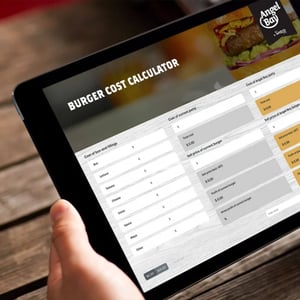
Burger Yield Calculator
How much of what you buy actually makes it onto the plate?
Raw mince loses moisture and fat during cooking, so the weight you buy isn’t necessarily the weight you serve.
Use our Burger Yield Calculator to compare the estimated cooked yield of raw mince with an Angel Bay burger patty, and see how much raw mince you may need to deliver a comparable finished portion.
Why burger yield matters
The price you pay for raw mince isn't necessarily its true cost once cooked.
Moisture and fat lost during cooking reduce the amount of product you have left to serve. Understanding this difference helps you compare patty costs based on finished portions, rather than starting weights.
It's not just what you buy. It's what ends up on the plate.
Calculate your raw mince yield
Tell us what you're currently using and we'll estimate how much remains after cooking.
How does this compare with Angel Bay?
Angel Bay patties are already part-cooked, so the cooking loss in your kitchen is different from that of raw mince.
Our Technical team's cooking trials found that an Angel Bay Standard 120g patty delivers approximately 103g once fully cooked.
To achieve the same cooked portion using raw mince, you'd need to start with approximately 143g.
That's why it's important to compare what ends up on the plate, not just the weight you start with.
A few grams can add up quickly
When you're serving burgers at volume, cook loss affects how much product you need to buy.
To serve 100 burgers with an equivalent cooked patty portion, you'd need approximately 14.3kg of raw mince compared with 12kg of Angel Bay Standard patties.
That's an additional 2.3kg of starting product, before considering labour and other preparation costs.
What does that mean for your burger margin?
Cooked yield is only one part of your burger's true cost.
Once you understand what your cooked patty is costing you, use our Burger Profit Calculator to factor in your other ingredients, labour, overheads and selling price.
About these calculations
The figures used in this calculator are based on cooking trials conducted by the Angel Bay Technical team to compare the cooking yield of raw beef mince patties with Angel Bay Standard 120g part-cooked frozen beef patties.
How we tested
Raw beef patties were prepared using 85CL and 90CL mince, with no additional ingredients. Patties were tested at 100g and 120g starting weights and cooked on a hot plate or in a frying pan to a core temperature above 75°C.
Angel Bay Standard 120g part-cooked frozen patties were tested using hot plate, frying pan and oven cooking methods.
What we found
- Raw beef mince: An average cooking yield of approximately 72%, equivalent to 28% cook loss.
- Angel Bay patties: An average final-cook yield of approximately 86%, equivalent to 14% cook loss when cooking from their supplied part-cooked weight.
These results form the basis of the calculator's estimated cooked mince cost and like-for-like cooked portion comparison.
Important information
This calculator is intended as a guide only. Results are based on controlled cooking trials and the information entered by the user. Actual cooking yields, portion weights and costs may vary depending on mince composition, patty size, cooking method, equipment, temperature and preparation.
The Angel Bay yield figure reflects the final cooking stage of a part-cooked product, not the total cooking loss from its original raw weight.
Results are estimates and should not be taken as a guarantee of actual yield, cost savings or product performance.
Arrange a call with a rep
Fill out your details and one of our reps will be in touch with you.