
.jpg?width=300&name=American%20Double%20Cheeseburger%20-%20LS%20no%20product(1).jpg)
From saddle flat to Friday night smash patty
We all know that feeling at dinnertime: you’ve got the Angel Bay patties in the freezer, you’re pulling the sides together, and maybe you're half racing the clock. But it’s good to remember that even the humble burger had to start somewhere, and what a wild ride it’s had.
From ancient times to carnival fairs, from bread‑and‑knife tables to fast food counters, here’s a deeper dive into the (often contested) history of the burger, and why every time you fire up the pan, you’re part of that legacy.
A long lineage — ground meat patties through history
People have been flattening and cooking minced or ground meat long before buns and burger branding existed. Some food historians trace patty‑like dishes all the way back to antiquity. For example, a dish known as isicia omentata , essentially a spiced, flattened meat patty, appears in a Roman cookbook, showing that the concept of seasoned, ground meat shaped into patties has been around for centuries.
Fast forward through the ages: by the 17th–18th centuries, the city of Hamburg, Germany had earned a reputation for quality beef and a style of minced‑beef steak. German immigrants brought this “Hamburg steak” to the United States in the 1800s, a dish often served with onions, maybe potatoes, and eaten with knife & fork.
So long before anything called a “hamburger sandwich,” the idea of grinding meat to make it more tender and using cheaper cuts, making good use of all parts, was a practical solution. The burger, in this sense, is part of a long tradition of smart cooking and making the most of quality cuts.
The great debate — multiple origins for the first “burger sandwich”
The short version? The burger didn’t have one birthplace, it evolved wherever people needed food that was quick, filling, and affordable.
The leap from a patty on a plate to a patty between bread (a sandwich) happened in the United States during the late 1800s–early 1900s, but who truly “invented” it? That’s where the legends begin.
Frank Menches & Charles Menches (1885) - One of the most often‑cited “first burger” stories comes from these two American vendors. At the 1885 Erie County Fair (in Hamburg, New York), they reportedly ran out of pork for their sausage sandwiches, substituted ground beef, seasoned the lot, and served it between bread, naming it after the fair’s locale.
Charlie Nagreen (also 1885) - According to local legend, this 15‑year‑old vendor at the Seymour (Wisconsin) Fair flattened a meatball and placed it between bread to help fairgoers walk and eat, a practical and portable twist. Many credit him as “Hamburger Charlie,” one early pioneer of what would become the burger sandwich.
Louis' Lunch, Connecticut (1900) - Another strong claim comes from this small lunch wagon run by Louis Lassen. The story goes that in 1900, a customer asked for something quick and portable, so Lassen grilled a beef patty and tucked it between two slices of toasted bread. Some recognise this as the first “hamburger sandwich” sold in a traditional eatery rather than at a fair.
Because multiple stories exist, all credible to some degree, it's hard to point to a single “birthplace.” Most historians agree the modern burger emerged somewhere between 1885 and 1904.
 The bun, the chain, and the burger’s rise to global fame
The early burgers sold at fairs or snack stalls were often served on simple bread or toast, not the sesame buns we think of today. It wasn’t until the early 20th century that the burger began evolving into the sandwich icon we recognise.
Then came a big turning point: in 1921 the first dedicated fast‑food burger chain, White Castle (in Wichita, Kansas), opened its doors. Their mission: make burgers cheap, quick, consistent and widely accessible. They offered small, square beef patties for just a nickel, affordable, easy to eat, and perfect for a growing industrial society.
That change transformed the burger from occasional fair‑food or lunch‑wagon novelty into a mass‑food phenomenon. From there, burgers spread across America and the world, becoming the global symbol of convenience, comfort, and quick satisfaction.
So next time you slap down your Angel Bay patty on the grill, you’re not just cooking dinner. You’re nodding to centuries of cooking-smarts, immigrant adaptation, street‑food hustle, and big‑food evolution.
What this means for you, right now
Here’s the cool part: when you grab that pack of Angel Bay patties and whip up burgers for the family, you’re continuing that legacy.
- Like the Mongol horsemen, you’re flattening meat.
- Like the Germans, you’re using top-quality beef and lamb.
- Like the early vendors, you’re making it portable.
- Like the fast food pioneers, you’re keeping it consistent.
Only now, it’s made better: premium NZ beef and lamb, made in New Zealand, and no soggy saddle required.
 Your dinner, with a bit of legacy
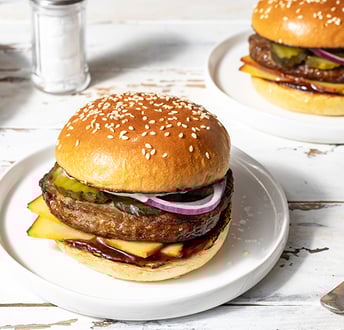
So here’s your simple burger blueprint:
- Grab your Angel Bay patties from the freezer.
- Slap them on a hot BBQ or pan.
- Stack them into a soft bun, lettuce wrap or bread, whatever suits.
- Add your fave toppings: cheese, pickles, avo, beetroot? Up to you.
- Sit down, pass the sauces, and enjoy a moment that connects centuries.
Because feeding your whānau is about more than filling plates, it’s continuing a story of resilience, simplicity and shared meals. A Kiwi take on a global classic.
So next time you flip a patty or build a burger, remember: you’re not just smashing dinner. You’re smashing it.
Disclaimer: Because the burger’s origins are debated, this isn’t a definitive history — but a look at the most widely cited theories.
Sources include: From Mongol Snack to Fast Food Icon: The History of the Hamburger - Discovery UK, The History of the Hamburger: From Street Food to Fine Dining - BurgerLocator.com, Hamburger - Wikipedia, Charlie Nagreen - Wikipedia, Louis' Lunch - Wikipedia, History of the hamburger - Wikipedia, https://en.wikipedia.org/wiki/History_of_the_hamburger_in_the_United_States, Our History - White Castle, How Hamburgers Became an Iconic American Food.